Tillbook for merchants
Your sales are your credit.
Take payments in USDC on Monad. Every sale builds a record any lender can see. Draw an advance and repay it a little from each sale.
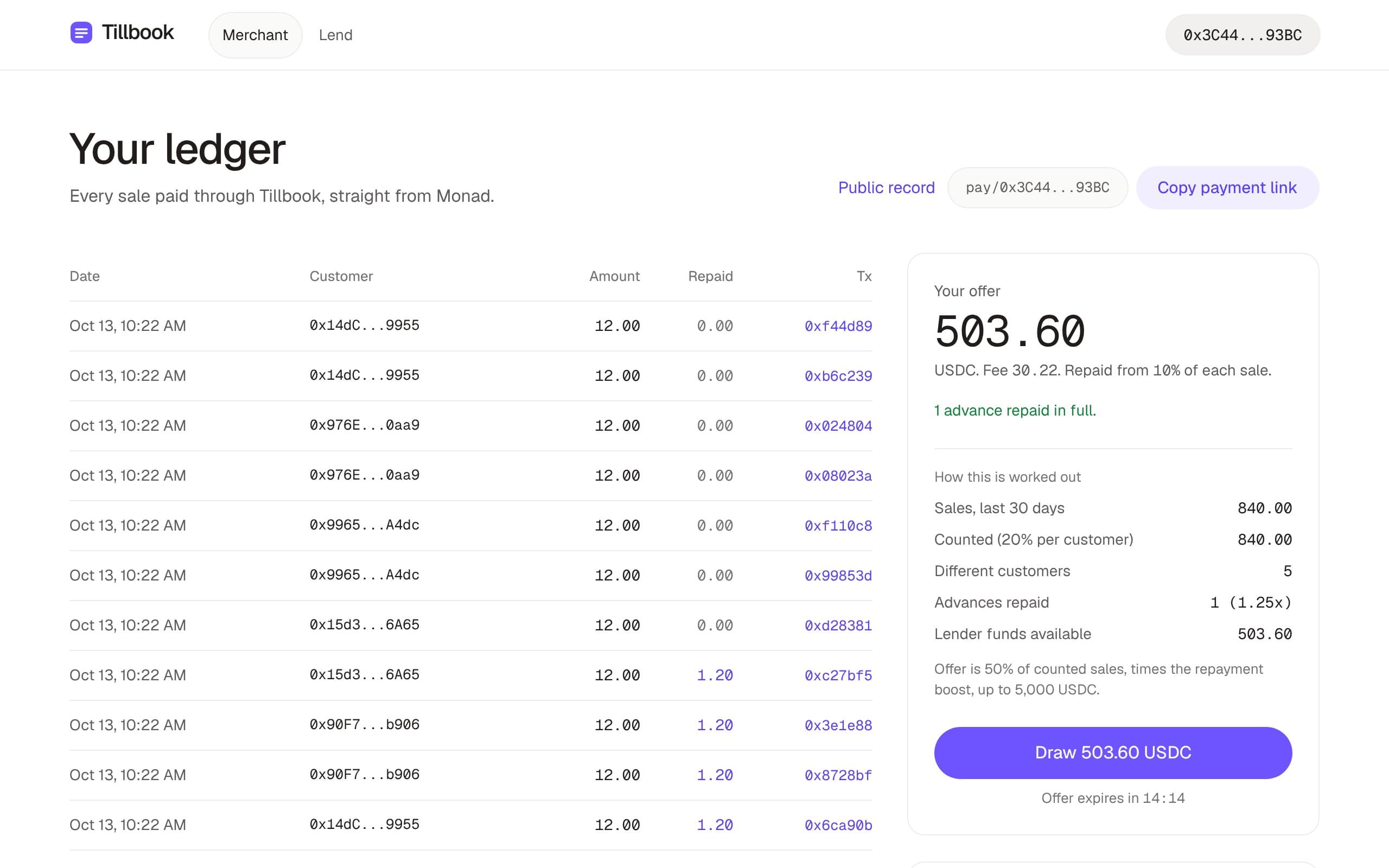
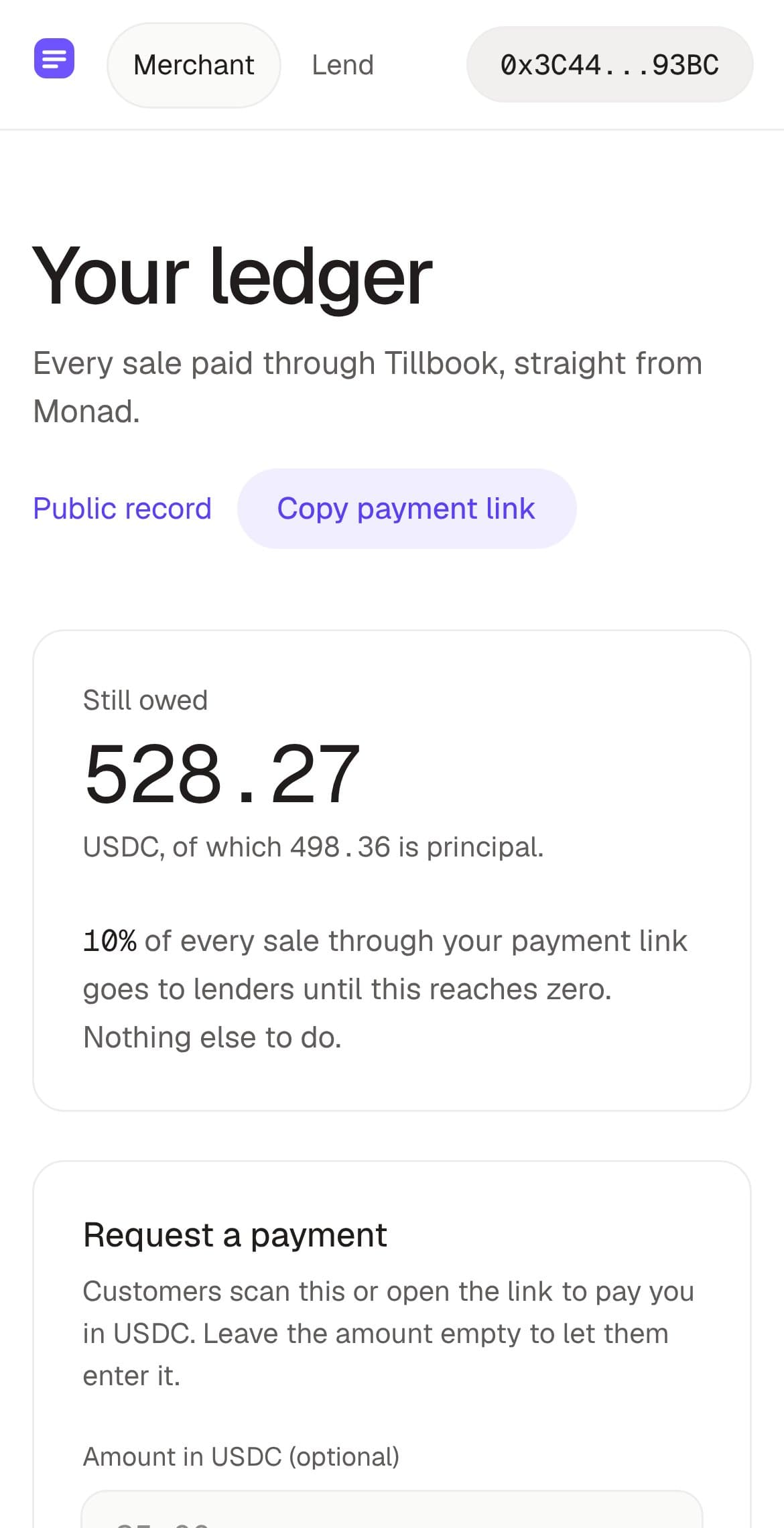
Dashboard from a test run on a fork of Monad mainnet with live USDC.
Live on Monad
- Reading...
- In the lender pool
- Reading...
- Advanced to merchants
- Reading...
- Sales paid through Tillbook
- Reading...
- Advances repaid in full
Read from LenderPool and SplitRouter on Monad, refreshed every few seconds.
Tillbook for lenders
Lend against real sales.
Deposit USDC. Merchants repay from every sale, and the fee on each advance comes back to the pool as they do. Withdraw anything that isn't lent out, any time.
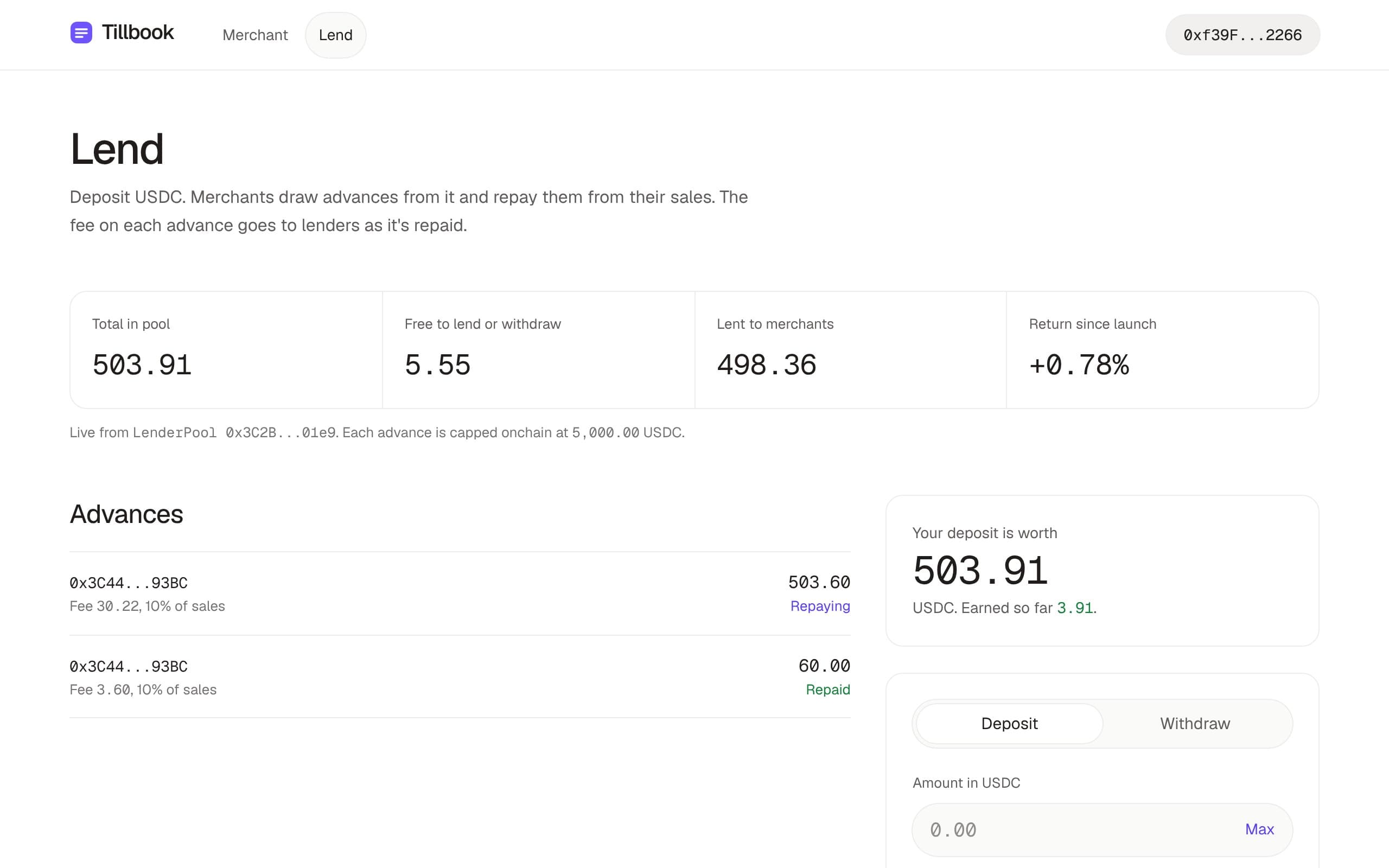
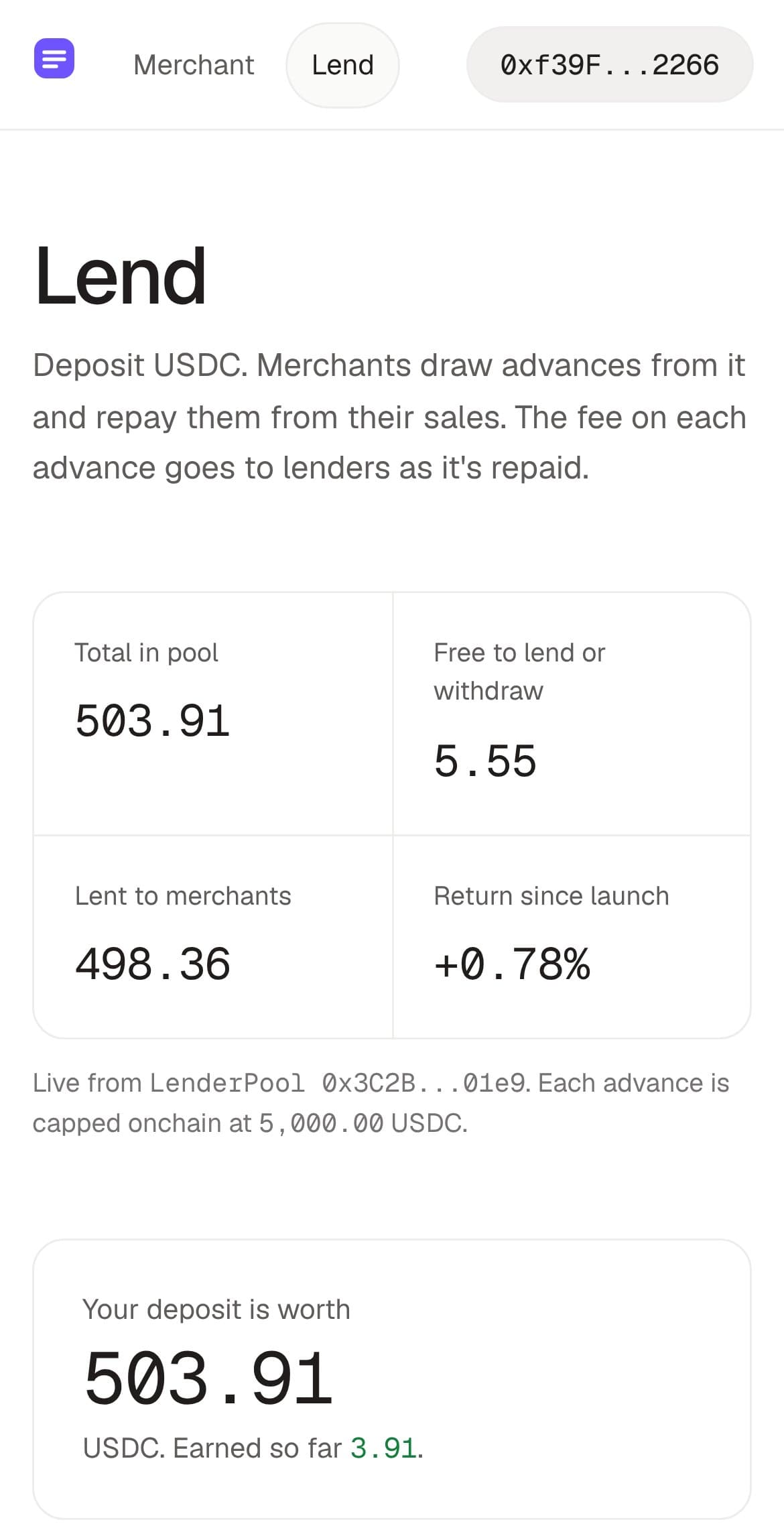
Lend screen from the same test run on a fork of Monad mainnet with live USDC.
Trusted by default
Open source, onchain and capped. Every claim below links to the code or test that proves it.
- No admin keysNo owner, no pause, no upgrades. Lender funds can only move by the contract rules.
- 5,000 USDC capHard limit per advance, set in the contract at deploy. A leaked signing key can't go past it.
- Fees paid as sales repayLenders earn each advance fee slice by slice as merchants repay it, not all at once when the advance is drawn.
- 1,336 tests131 contract tests including fuzz and invariant runs, 1,202 underwriter tests and 3 indexer tests.
- Tested on live USDCThe full loop runs against the real USDC contract on a fork of Monad mainnet.
- 119,601 gasMeasured cost of a payment that also repays an advance, on that mainnet fork.
Built on
Open rails, end to end
No private ledger and no custom token. Tillbook runs on public chain infrastructure and tools that real teams ship with.
 MonadMainnet, chain 143. Fast, cheap blocks are what make a repayment inside every single sale practical.
 USDCCircle's native USDC on Monad. Every payment, advance and repayment settles in it.
 OpenZeppelinThe pool is an ERC-4626 vault with EIP-712 offers, SafeERC20 transfers and reentrancy guards.
 PrivySign in with email or Google and get a Monad wallet on the spot. No extension, no seed phrase.
 EnvioA HyperIndex indexer tracks every payment, advance and repayment, so ledgers and offers load instantly.
 AlchemyContract reads and offer pricing run through Alchemy's Monad RPC, with the public RPC as backup.
Questions
How is my offer worked out?
Half of what you sold through Tillbook in the last 30 days, with no single customer counting for more than 20%. You need sales from at least 3 different customers. Each advance you repay raises the multiplier, up to 2x, and no advance can go above 5,000 USDC.
What does an advance cost?
A flat 6% fee, shown before you draw. There's no interest and no daily debit. 10% of each sale goes to repaying the advance until it's cleared, and the rest lands in your wallet. You pay normal Monad network fees on transactions.
What happens if a merchant stops getting paid through Tillbook?
Repayment stops with it, because it only comes from sales. There's no collateral and no collections. That merchant can't draw another advance until the open one is repaid, and the onchain record shows it to every lender.
Can lenders lose money?
Yes. If an advance is never repaid, the pool carries that loss. The per-advance cap of 5,000 USDC limits how much any single merchant can take, and offers depend on sales history from several different customers.
When can I withdraw from the pool?
Any time, up to the USDC that isn't lent out. Money in active advances comes back to the pool as merchants make sales, and becomes withdrawable then.
What do I need to get started?
A browser wallet such as MetaMask or Rabby, connected to Monad, with USDC. Customers paying you need the same.
Start building your record today.
Share your payment link, take your first sale, and watch your offer grow.